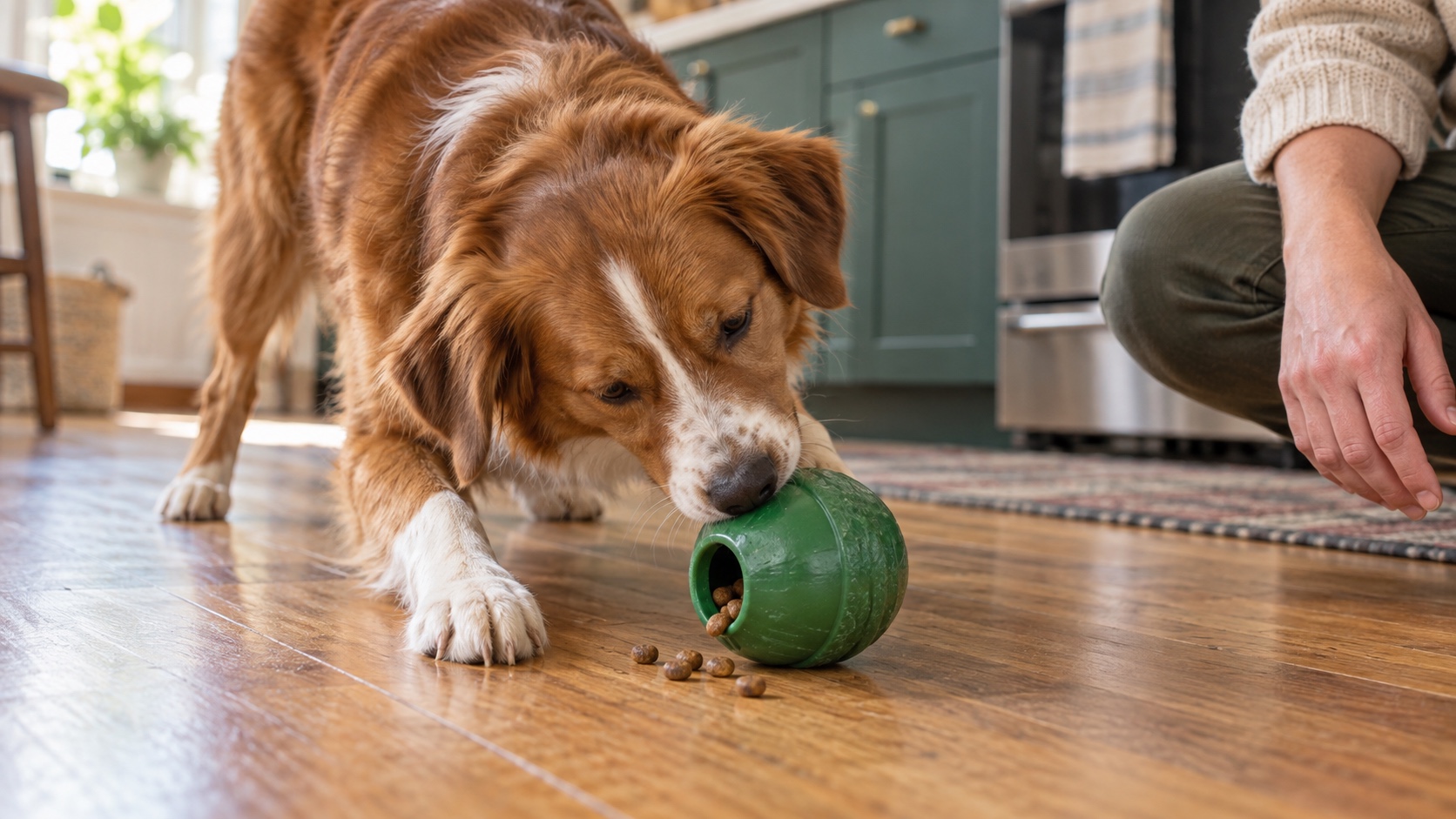
A food-dispensing toy changes one ordinary event: instead of receiving food from an open bowl, a dog has to move, roll, lick, nudge, or manipulate an object to reach it. That can slow access to food, add activity to a routine, and give some dogs a useful task. It can also add calories, frustration, conflict, or a swallowing hazard if the toy and plan do not fit the dog.
The evidence is promising in specific settings, but it is not a universal guarantee of better behavior, weight loss, or “mental exercise.” The most reliable benefits come from treating the toy as part of a measured feeding plan—not as an unlimited extra.
What the research can and cannot tell us
One randomized, repeated-measures crossover study followed 26 client-owned indoor dogs. When the dogs were fed using a food-dispensing toy, their average total daily activity increased by 12 percent and walking time increased by 26 percent, while running time did not change. The authors concluded that toy feeding could be a practical way to increase activity during weight-loss programs. The study abstract is available through PubMed ↗.
That result is useful, but its boundaries matter. It was a small, short study of indoor companion dogs, and an activity increase does not by itself demonstrate weight loss. Body weight still depends on energy intake, energy expenditure, health, and adherence to the overall plan.
Earlier work with 17 kennelled laboratory dogs found that a food-enrichment toy produced more appetitive behavior and activity and less barking during the observation period. The 2008 Applied Animal Behaviour Science study ↗ offers evidence that food toys can alter behavior in a kennel context, not proof that every home dog will respond in the same way.
Results are not uniformly positive. A more recent short-term study of companion dogs found no significant effects on activity, consumption rate, or cognitive-bias measures when toys were provided. Its PubMed record ↗ is a useful reminder that toy type, dog, setting, duration, and outcome measure all shape what researchers observe.
The fairest summary is modest: food-dispensing toys can change how some dogs obtain food and may increase activity or alter behavior in certain circumstances. Evidence is too limited and mixed to promise a specific behavioral or health outcome for every dog.
Portion control begins before the toy is filled
The simplest system is to measure the dog’s full daily food allowance first. Then take the toy’s filling from that measured amount.
For example, if a veterinarian-guided plan calls for a measured daily quantity of kibble, set out that full quantity in a container each morning. Use some in meals and some in the toy. When the container is empty, the planned daily ration is finished. This prevents a well-intentioned “enrichment snack” from quietly becoming a second meal.
The American Animal Hospital Association includes food-dispensing toys in its feeding-plan guidance ↗ as one way to control access and amount while potentially affecting activity. The underlying food should still be complete and balanced when it is intended as the main diet, and the amount should match the dog’s needs.
If the toy contains treats, cheese, peanut butter, biscuits, or another addition rather than the usual food, count those calories too. The World Small Animal Veterinary Association’s treat guidance for dogs ↗ recommends keeping treats below 10 percent of daily calories so that at least 90 percent comes from complete and balanced food. “Ten percent” is a ceiling, not a target, and a veterinarian may advise less for a dog with obesity, pancreatitis risk, food sensitivity, or a therapeutic diet.
Labels and household spoons make calorie estimates easy to misread. Check calories per cup, can, piece, or gram, and use the same measuring method consistently. For weight-management or medical cases, ask the veterinary team for a daily calorie target rather than relying only on the feeding range printed on the package.
The food format matters less than the daily math
A puzzle can hold measured kibble from a complete diet, a small amount of wet food, or an approved add-on when the toy is designed for that texture. Foods from Purina, Hill’s, Royal Canin, The Honest Kitchen, Instinct, or Brothhh ↗ differ in nutritional role, calorie density, and label directions; naming them here illustrates formats, not equivalent products or endorsements. Brothhh and Veterinarian Digest share common ownership.
Check the package’s calorie statement and intended-use language before choosing an amount. A product labeled for intermittent or supplemental feeding should not silently displace a large share of a complete and balanced diet. If the calories for the amount actually served are unclear, contact the manufacturer rather than estimating from a scoop, packet, or visual impression.
Choose the toy for the dog in front of you
A toy should be large enough that the dog cannot swallow it and durable enough for that dog’s chewing style. Those are individual judgments. A toy that is appropriate for a small, gentle dog may be dangerous for a powerful chewer; a hard, heavy toy may be unsuitable for a dog with dental disease.
Consider:
- Size and shape. The whole toy and any removable parts should be too large to swallow. Openings should not trap the jaw, tongue, or paw.
- Material and condition. Follow the manufacturer’s intended use. Do not offer a cracked, deeply gouged, torn, or loosening toy.
- Food format. The filling should be safe for that dog and compatible with the toy. Avoid ingredients the dog cannot tolerate and foods known to be toxic to dogs.
- Skill level. A first session should be easy enough to solve. Food placed loosely around the opening is less frustrating than a tightly packed or frozen challenge.
- Environment. Give the dog quiet space. Multiple dogs should not compete for a high-value food toy.
- Health and mobility. Dogs with dental pain, swallowing difficulty, arthritis, vision loss, food allergies, or prescribed diets may need a modified activity or a different option.
AAHA’s indoor enrichment guidance ↗ recommends matching toys to size and chewing style, supervising a new toy, and inspecting it for damage. WSAVA likewise advises supervision and an appropriate size and shape.
Introduce it as a skill, not a test
Some dogs immediately roll or paw a toy. Others walk away, bark at it, guard it, or chew the object instead of working for the food. Those responses are information, not failure.
Start with a familiar food that falls out easily. Let the dog investigate without repeated prompting. If the dog succeeds comfortably, make the next session only slightly more difficult—perhaps by using a little more food or a toy with a less direct opening. Difficulty can be increased gradually, but it does not need to be maximized.
Stop or simplify the session if the dog shows persistent distress, frantic biting, repeated pawing without progress, avoidance, or escalating guarding. A certified behavior professional or veterinarian can help when resource guarding, anxiety, or compulsive behavior is involved.
Novelty also deserves moderation. Rotating two or three safe options may sustain interest, but there is no requirement that every meal become a puzzle. Some dogs do better with predictable bowls, snuffle-style feeding, scatter feeding in a controlled space, or training rewards taken from the daily ration.
Supervision is active, especially at first
During early sessions, stay close enough to see how the dog uses the toy. Active supervision means noticing whether pieces are loosening, the toy is being swallowed rather than manipulated, food is becoming inaccessible, or another pet is approaching.
Remove the toy when the session ends. Inspect it before the next use and follow the maker’s cleaning instructions. Food residue and moisture can collect in seams and cavities; a design that cannot be inspected and cleaned adequately may not be a good everyday feeding tool. Discard and replace a damaged toy rather than waiting for a piece to detach.
If any part may have been swallowed, contact a veterinarian promptly for advice. Repeated retching, vomiting, abdominal pain, marked lethargy, loss of appetite, or difficulty breathing requires urgent veterinary attention.
Food toys are not right for every meal—or every dog
A toy can be a poor choice when it creates competition in a multi-dog home, intensifies guarding, aggravates a dental or orthopedic problem, or encourages destructive chewing. It may also conflict with a veterinary feeding plan that requires tightly timed meals, careful texture, or close monitoring of intake.
For a dog who must eat promptly with medication, a toy that leaves an uncertain amount uneaten can make dosing harder. For a dog on an elimination or therapeutic diet, even a thin smear of an unapproved filling can undermine the plan. Dogs with a history of ingesting non-food objects need individualized advice before receiving any puzzle feeder.
The goal is not to make food difficult. It is to create a safe, observable activity while preserving nutrition and portion control.
A five-step routine that keeps the math honest
- Set the daily amount. Use a veterinarian-guided calorie target when one is available.
- Measure once. Place the whole day’s ration in one container.
- Fill from that ration. Subtract any separate treats and toppers from the day’s calorie allowance.
- Supervise and adapt. Begin easy, watch the dog’s technique, and stop if the toy is damaged or the dog becomes distressed.
- Record what matters. For dogs in a weight plan, track body weight, body-condition score with the veterinary team, and how much food is actually consumed.
This routine turns a toy from an extra into a feeding tool. It also makes it easier to tell whether the activity is helping the individual dog.
The practical takeaway
Food-dispensing toys can make access to a measured ration more active and engaging. Small studies show benefits in some dogs and settings, while other research finds no measurable short-term change. That mixed evidence supports a trial with observation—not a promise.
Choose a suitable toy, fill it from the daily ration, introduce it at an achievable difficulty, supervise, inspect it, and change course when the dog’s behavior or health says the setup is not working. The best food toy is not the most complicated one. It is the one that fits safely into a balanced, measurable routine.
Sources and further reading
- BMC Veterinary Research: Food-dispensing toys and physical activity in indoor dogs ↗
- Applied Animal Behaviour Science: Feeding enrichment in kennelled dogs ↗
- Veterinary Sciences: Short-term toy provision in companion dogs ↗
- AAHA: Feeding Plans for Healthy, Appropriate-Weight Cats and Dogs ↗
- WSAVA: Feeding Treats to Your Dog ↗